Who is America's Working Class
And what economic policy do they need

If you read the news about elections in the U.S., whether recently passed or upcoming, you might have notice two threads winding through many stories.
Thread one:
The working class is politically important, if not the most politically important group in the U.S. today, and their support has become the litmus test for Democratic candidates.
Thread two:
White men without a college degree switched political parties and, while they used to vote Democrat, now vote Republican.
[[For example: New York Times, Guardian, Washington Post, NPR, Financial Times, Bloomberg, The New Republic, New York Times Again, New York Times Again, Washington Post Again, The Atlantic, Le Monde (oui, le monde!), the BBC, and a smattering of smaller outlets like Jacobin Mag, The Free Press, the New Labor Forum, this centrist think tank podcast, and The Conversation.
These threads have either i) an underlying assumption or ii) an implicit conclusion: The assumption is that ‘working class’ is synonymous with ‘white men without a college degree.’ The conclusion is that the working class may be a large group but white men without a college degree are the most politically important among them.
In today’s letter:
Warning: I’m Not a Political Scientist
(Worse?) I’m an Economist
Who the Working Class Is
What the Working Class Needs
Rhetoric that is a Distraction and Disservice
Who Benefits?
Warning: I’m Not a Political Scientist
A professor of political science at Syracuse just released a book called The Transformation of the Republican Party. He said in an interview that researching the book led him to take on more directly this idea that Democrats lost white working class voters. The conventional wisdom is that in the 1960s and 70s, Democrats became the party of civil rights, this alienated white people, and Republicans capitalized on that. The New Deal economic coalition, which had lasted for more than thirty years, came apart because of race.
But what he found was that while there’s probably some truth there—that Republicans are very good at capitalizing on race and identity politics—the voting data doesn’t support the story. His research shows:
Support for the Democrats among the working class whites peaked in 1940 and then went through declines/holding steady for the next 15 years, according to Gallup.
Between 1952-2020, the Democrats only won a majority of working class white in one election: 1964 (Landslide Lyndon), according to voter data.
It’s less that the Democrats lost working class whites, more that they’ve never really had them. The peer-reviewed paper is here and the draft version here. Apparently this has inspired him to write a book, still in progress, called The Myth That Democrats Lost the Working Class Whites.
I’m not a political scientist so I don’t really know how to explain this finding to you with context or backstory, but my instinct is we only have myths because someone benefits from them. This is where my dad, the criminal judge, would turn and say “Cui bono?” Who benefits from co-opting the working class?
Let’s start from scratch.
(Worse?) I am an Economist
One thing about being an economist that makes us kind of awful (useful in our own way sometimes, just saying!) is that we tend to ignore findings from outside our field. Political scientists and historians will incorporate economic findings into their research and study, but the reverse isn’t true, at least not as a rule.
So pretend you didn’t know anything about politics, elections, or their history and you were given the task: find out what the working class in America needs right now from federal policy.
Who the Working Class Is
Vaguely…
There’s not a single definition of working class. The concept emerged in the Industrial Revolution as people left farms to work in factories. Even then, to a certain degree, the working class was the in-betweener: they were different from the farm workers who owned or lived on the land; different from the shopkeepers, merchants, or craftsmen who owned or operated their own business; different from the capitalists who owned the factories. The working class was untethered, moving between places of employment without a permanent stake in their homes or their jobs.
Translated today, this class structure has evolved but holds up. The working class is above the very poor but below the middle class and the rich. Since 2002, Gallup has done annual polling of Americans and asks them to identify their class: lower, working, middle, middle-upper, upper. About a third of Americans say they are working class.
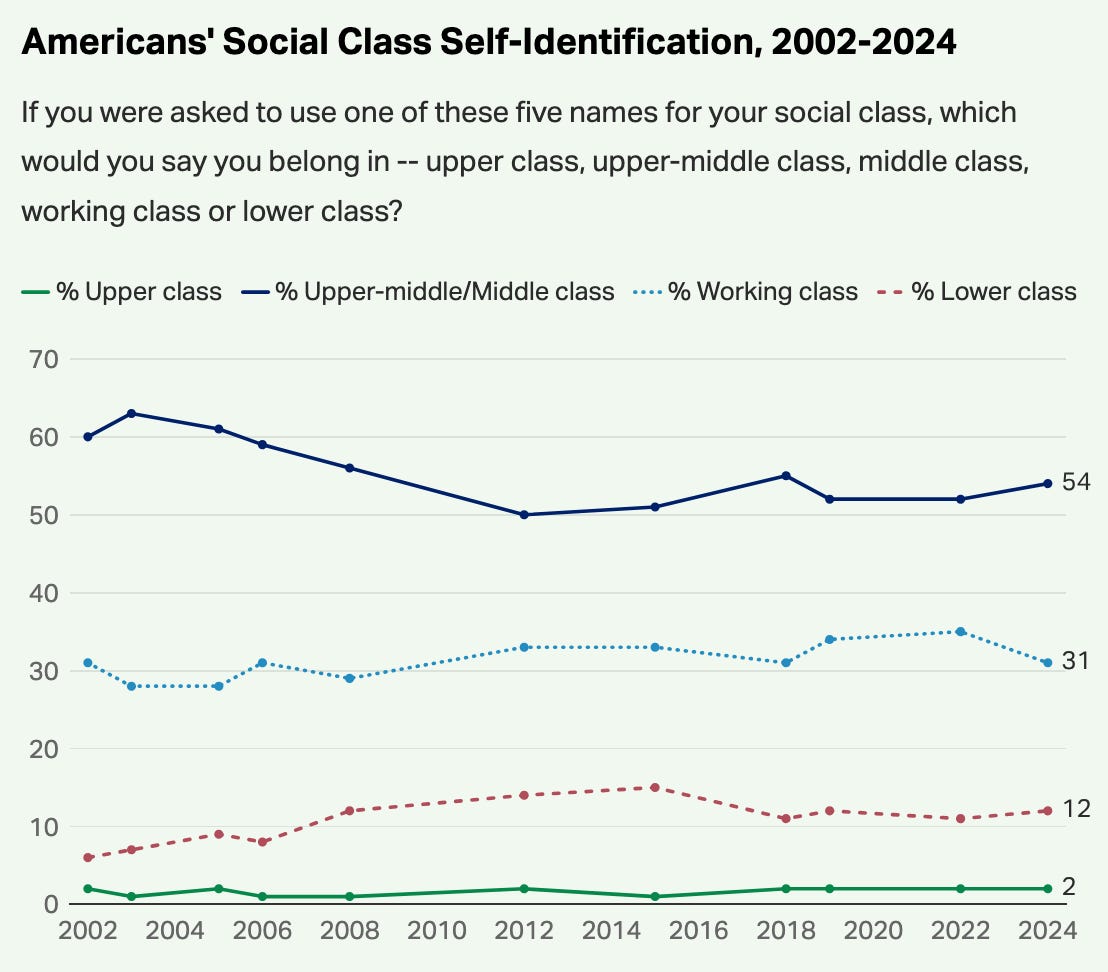
Check out this breakdown by demographic groups:
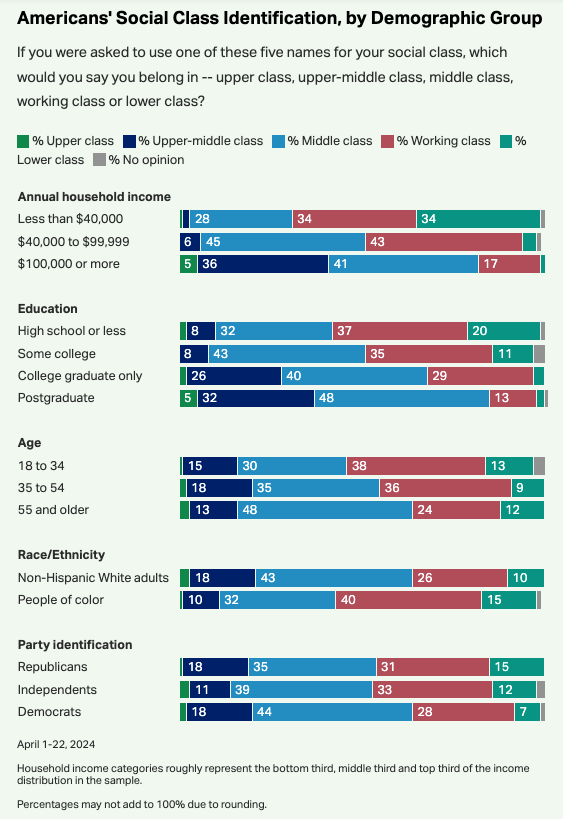
More specifically…
The vague but still somewhat intuitive definition of the working class is 1) workers who 2) aren’t middle class. What does that mean in America in 2026?
My approach is to look at low-paying jobs. The National Compensation Survey from the Bureau of Labor Statistics measures which workplace benefits are offered in the US. They rank jobs by the median wage reported by employers and give summaries by ordered groups: jobs whose median pay is in the bottom 10%, bottom 25%, next 25%, next 25%, top 25%, top 10%.
The table summarizes what share of jobs in those groups offer basic benefits.

Here’s what you need to see: The big jump in job quality is between the bottom 25% paying jobs and the next 25%, across almost every measure. In the lowest paying jobs, the majority of workers don’t get retirement, life, or health, and only a small majority get vacation, sick days, or holiday.
I think it’s fair to look at this table and say that there is a clear class divide in job quality.
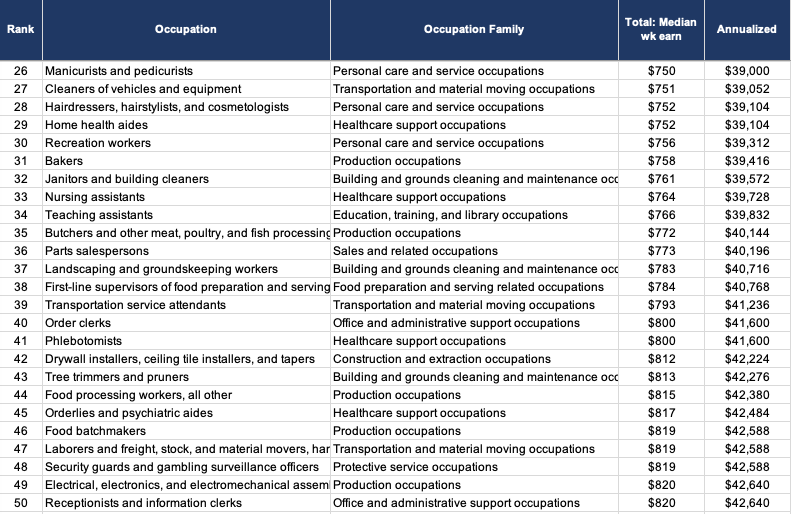
Now let’s do the same thing—find the lowest paying jobs—but in a different source. According to the Current Population Survey, also compiled by the Bureau of Labor Statistics, here are the lowest 25 paying occupations when ranked by the median pay reported by full-time workers.
The lowest paid occupation in the U.S. economy is hosts and hostesses, which is in the food preparation and serving occupation group. Full-time hosts and hostesses have a median weekly wage of $605, which if you sum over 52 weeks, comes out to $31,460 a year.
You’ll notice among these 25 lowest paid occupations that they are concentrated in service—food prep and service, sales, personal care, cleaning. Sharp eyes may see that childcare workers come in at number nine, better paid than waitresses but not as well paid as maids.
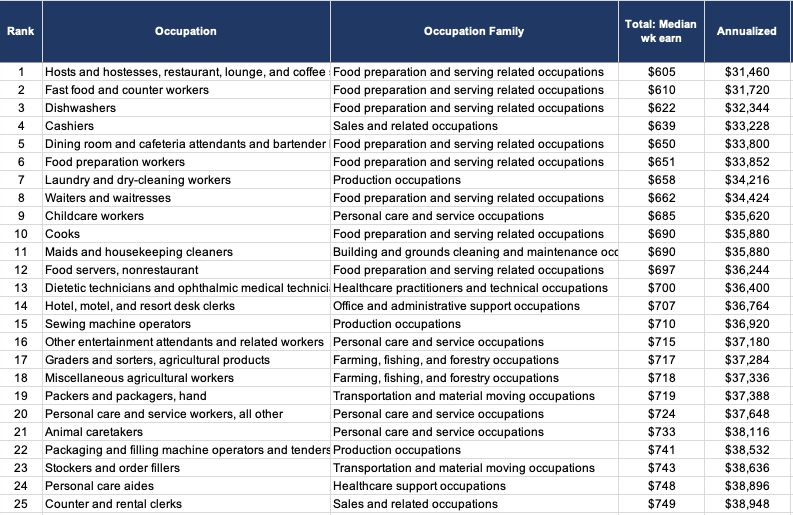
The next 25 continue the service theme, but expand to more in healthcare, education, and protection service. Also, some of the lowest rung of higher paying occupation groups are showing up, like production, transportation, and office support. All told, the 50 lowest paid occupations are those in which typical full time workers will make under $43k a year. (←just note, these occupations have many workers who are not full time)
What about the workers in those jobs? In the table below, I sum up the share of all workers in the lowest paying occupations and then the share of specific groups that are in the lowest paying occupations. I did it four times, for the lowest paid 10, 25, 50, and 100 occupations.
In the first column: of all workers in the US, 6% are in the 10 lowest paid occupations, 11% are in the lowest 25, 20% are in the lowest 50, and 35% in the lowest 100. The remaining columns illustrate that the lowest paid jobs are more likely to be jobs that women and people of color hold. Lowest paying occupations have more women and people of color working in them.
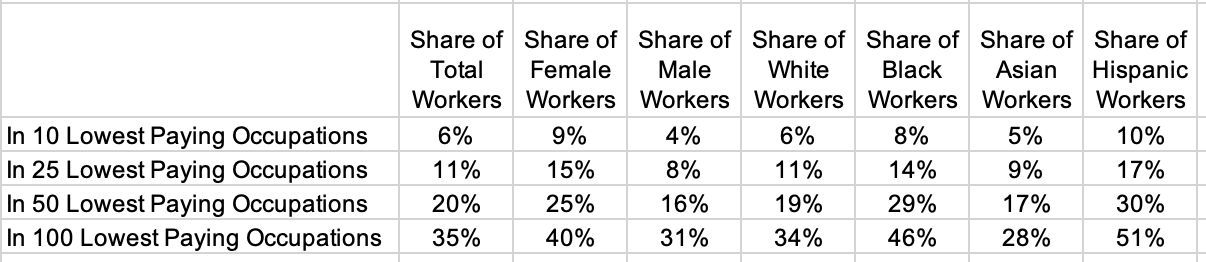
The other way to look at it is to look who works in each specific occupation and compare that to workers overall. For example, across all occupations in the US: 47% of workers are women but in the lowest 50 paying, it’s 58%—a nine-point difference. It’s the same pattern, lowest paying occupations have more women and people of color.
Upshots:
The worst paid jobs are in a class of their own in terms of benefits, which aligns with pulling heavily from the service occupations:
Service occupations are notorious for unregulated shift work, including no advance notice of schedule, changing schedule, cancelled shifts, clopening shifts, on-call shifts, extended shifts, highly punitive algorithms, and high turnover (read more at The Shift Project a research effort to document the extent and harms of unregulated shift work).
Service occupations are also at the center of most wage-and-hour violations, broadly referred to as “wage theft,” where workers are not fully paid for hours worked (read more at The Economic Policy Institute which estimated how large wage theft could be in a 2017 report).
And workers in those jobs are women and people of color, so likely both.
What the Working Class Needs
Based on what I showed above, the working class needs better pay, better benefits, and more support.
Part 1 - Pay
How to get the working class more money:
Raise the minimum wage
Require that all workers have paid sick leave
Require that all workers have paid vacation
Require that all workers have paid holiday or overtime on holidays
Regulate shift scheduling to require advance notice, pay for cancelled or on-call shift, ban clopening, require the use of overtime for last minute shifts, and prevent discrimination, retribution, or punishment for using time off
Fund and enforce wage and hour laws
Require all workers receive a paystub
Although the minimum wage and reducing wage theft are the only policies that could directly increase pay, it’s worth pointing out that having stability at work reduces turnover which increases income. For example, states that have mandated paid sick days have seen annual earnings increase by over $2k, not because workers took $2k of sick days, but because having a sick day and not being fired for it reduced job transitions so people worked (and earned) more.
Part 2 - Benefits
How to get the working class basic benefits:
Establish universal public health insurance program so that all individuals are covered and health insurance isn’t dependent on employer’s generosity
Establish an ‘Auto-IRA’ or ‘Self-401k’, universal retirement accounts that are managed by the government that workers, employers, and the government can contribute to
Employers have had decades of runway to offer benefits to their workers voluntarily and in those decades they’ve shown the working class won’t get them. If you think workers deserve health and retirement, this is how you get it. Otherwise, it’s lip service.
Part 3 - Support
The working class is more likely to be female, which means workers are more likely to have dependent children at home and more likely to provide some kind of caregiving role in their family for adult members. How to get them support:
Universal paid family leave that covers all jobs, regardless of pay, employer size, or tenure
Universal and free childcare, preschool, after school, and summer programming.
It’s not as hard as it seems. Paid family leave can achieve all of those things if it’s incorporated into Social Security. We have a provider network already for the care of children, but it needs to be expanded and funded by the federal government.
Rhetoric that is a Distraction and Disservice
A tectonic shift happened in our economy over the past fifty years and the federal government grossly, cruelly mismanaged it. Manufacturing employment, which was associated with high-wage, high-benefit unionized jobs for men without a high school degree peaked in 1979. The subsequent decades came with a barrage of automation and trade that decimated it. The dramatic fall after 2000 is called “China Shock.”
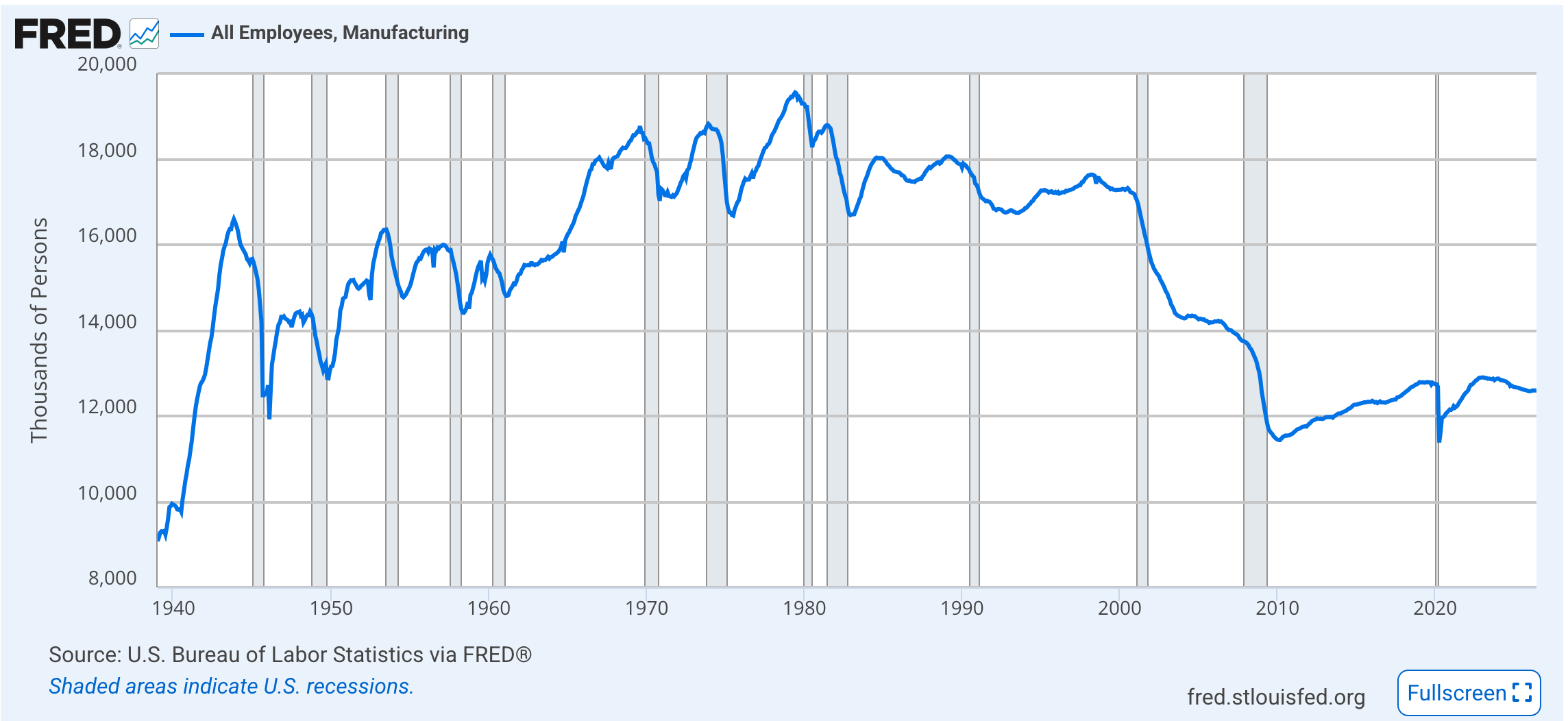
That’s the number of manufacturing jobs, but our population and workforce was growing that whole time. If you look at manufacturing employment as a share of all employment, you can see the decline started in the 1950s and has been a steady fall downward. By the time the peak number of jobs was reached in 1979, manufacturing had already fallen from 30 to 20% of employment.
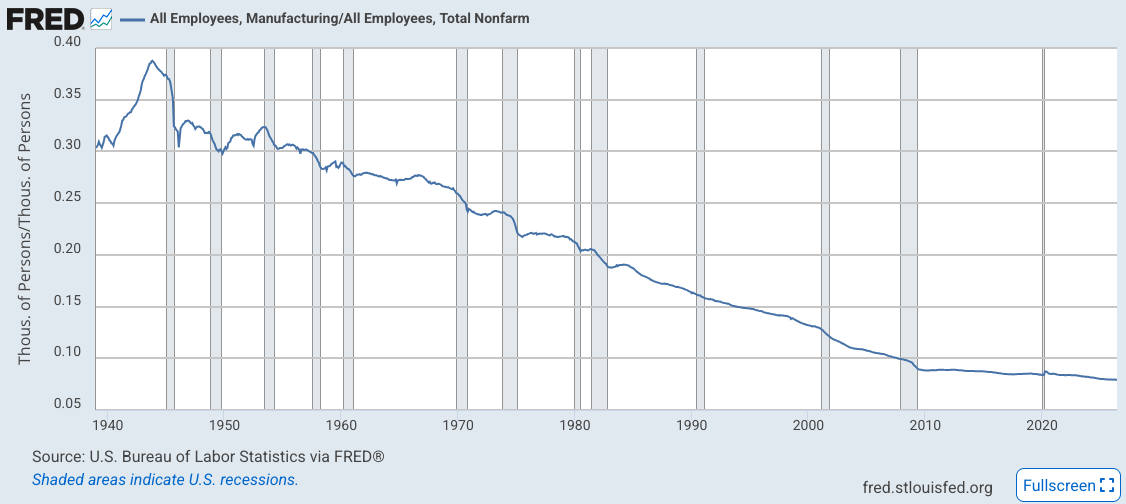
In raw dollar amounts, manufacturing wages have fallen behind the average in the private sector. The jobs weren’t just gone, the ones that were left didn’t have the same high relative pay that they used to.
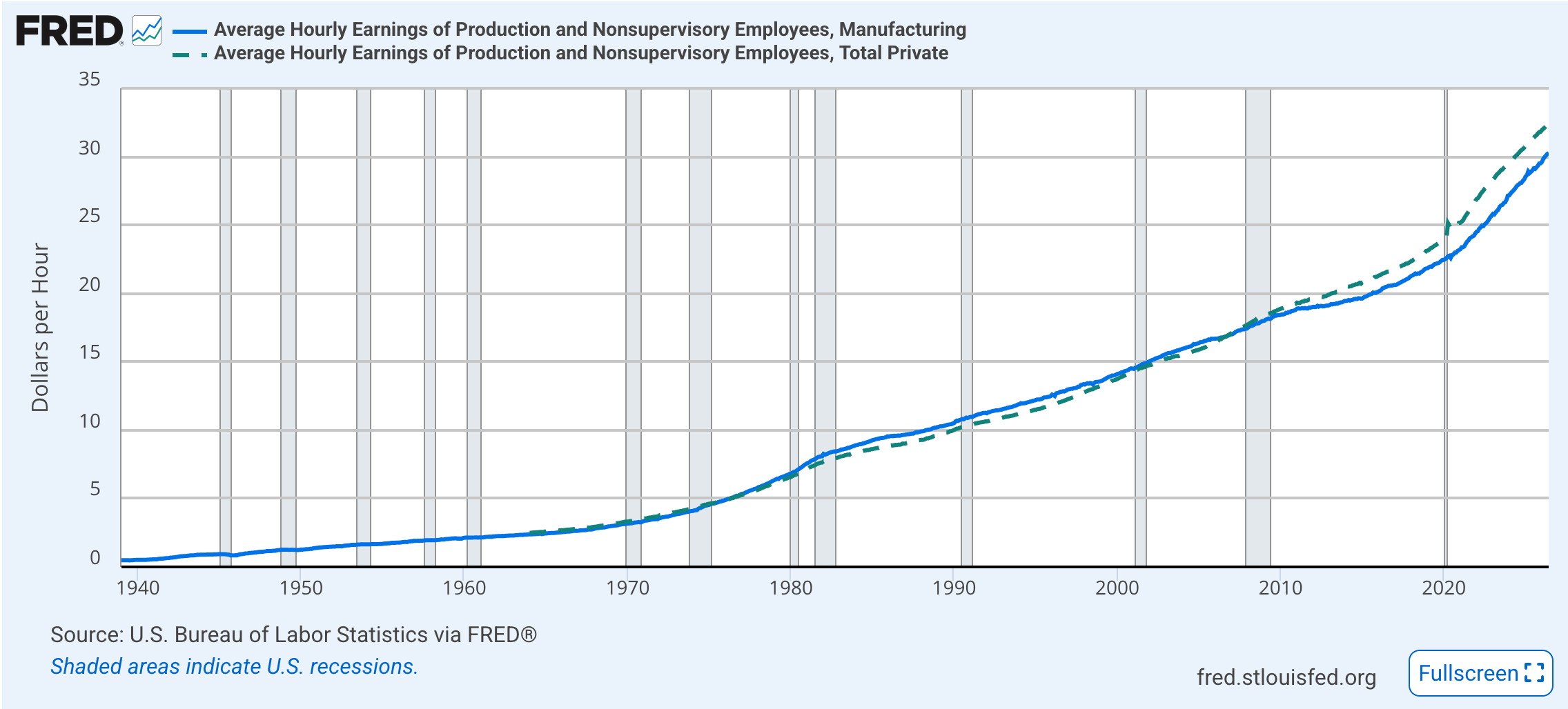
Conflating the loss of manufacturing jobs with the needs of the working class today is a distraction.
As I’ve laid out in this newsletter, it redirects attention from the terrible jobs in our economy, who works them, and the policies that can fix them. The working class is women of color. The working class needs pay, benefits, and support. It doesn’t matter how many blue collar jobs we’ve had or will have: these are the jobs that are bad now, the workers who are working them now, and the policy that can help now.
But it’s also a such a disservice to those white men without a college degree that are mourning the loss of economic dignity that they feel like they never had a chance to get. To start, it’s backward looking without being reflective. In 50 years, I would be surprised if there will be more than a handful of workers in most factories. There’s benefit to our communities and our economy to make things here, but it’s less and less likely jobs will be among those benefits. We should be looking back to diagnose just how badly we erred in managing this transition, a transition that is still ongoing.
Yet, so many politicians talk about manufacturing as if we can somehow bring back WWII-era employment level, and worse, as if manufacturing is the only way to have good high paying jobs. Lost in this hollow promise is any kind of recognition of what made those jobs good in the first place.
It wasn’t being on the line, it was being in a union.
We shouldn’t be talking about manufacturing, we should be talking about unionization. Creating tens of millions of manufacturing jobs is trying to hold back the tide. But job security, job quality, opportunity for training, good benefits—that’s all within reach.
Unionization is good for the economy, it tilts it away from inequality. Even today, states with higher unionization density have higher incomes. A report from the Treasury Department a few years ago did a round up of the benefits of unionization for workers; unions are associated with higher productivity and lower turnover, safer workplaces, and can even foster communication in the workplace.
Who Benefits?
Today’s working class needs robust labor laws, a better way of providing health and retirement, and basic support for their children. White men without a college degree want the income and dignity of unionized career paths.
Who benefits from talking about bringing back jobs that have been gone for decades? From warning liberals that they cannot win politically if they talk about ‘civil rights populations’ too much?
Keep your eye on the ball.