
What are we going to do about AI taking our jobs?
Easy: Fix the fallback.

The Fear
There’s a deep undercurrent of fear running through the labor market that AI will cause catastrophic job loss. In Gallup’s latest State of the Global Workplace Report, 18% of U.S. employees said it was very or somewhat likely that their job would be eliminated within five years.
Meanwhile, AI companies have positioned themselves as our saviors, encouraging talk about how destructive AI will be and then declaring that they have solutions for it, like an AI-wealth funded universal basic income.
Don’t listen to them. UBI isn’t a solution, it’s a cop out.
How AI Job Loss Works
When a technology is adopted into the workplace, it makes workers more productive i.e. they can produce more in the same amount of time with the technology than without it. As productivity changes, demand for labor also changes, and jobs are created and destroyed as a result.
So the crux of AI adoption is worker productivity.
The figure below shows output per hour of work (i.e. labor productivity) in the US from 1947 – 2026. It is a steady, increasing line with no clear and obvious technological advancement visible. Computers, hard drives, microchips, laptops, the internet, cell phones, emails, microsoft office—all quietly integrated. The only jumps are around recessions, when output recovers before employment does.
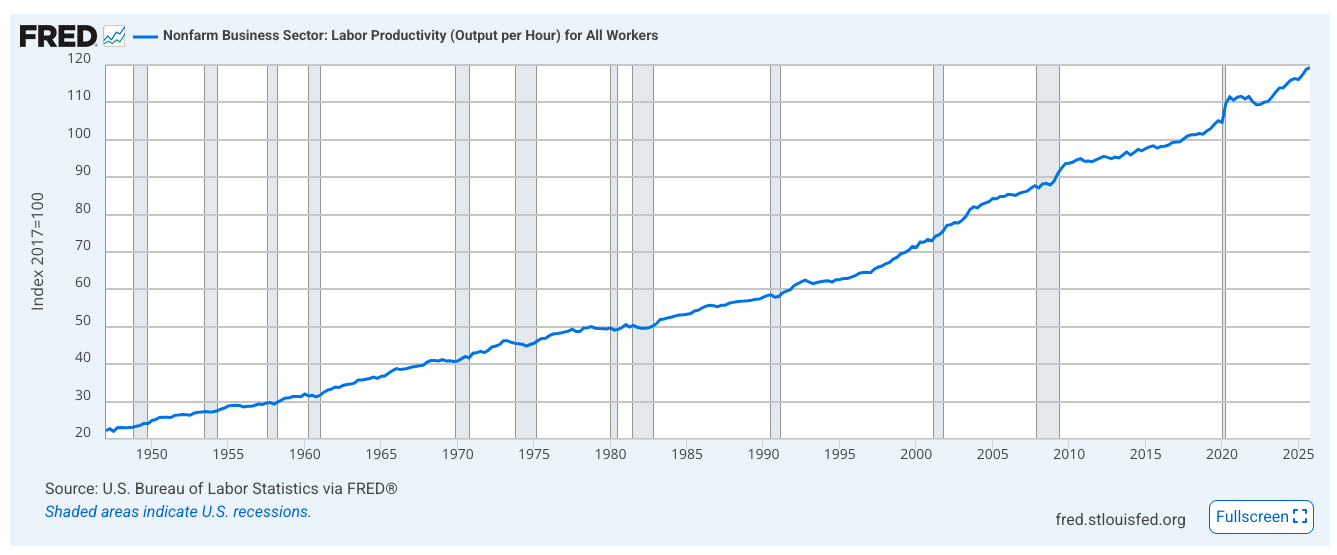
Source: BEA, via FRED.
How many jobs will we lose to AI? We don’t know, because we don’t know:
how quickly firms will adopt AI,
how quickly it will benefit their productivity, and
how quickly that adoption and productivity increase leads to headcount changes, including
the number of people who are hired as a result, and
the number of people who are fired as a result.
Even after the fact, we won’t be able to measure these things that well and if we did, we wouldn’t be able to attribute them to AI with a high degree of certainty. A lot is going on in the economy at any given time. If you look at the graph of productivity, you don’t see innovation adopted with the same kind of leaps as its invented.
In sum: We have to assume AI job loss is coming, but we can’t assume much more than that.
What do we do about AI? Hard, vague question.
What do we do about job loss? Fix unemployment benefits.
Why UI and Not UBI?
Sam Altman, the most vocal AI leader cum proponent of universal basic income (UBI), wrote in 2014 that AI will render millions of workers non-employable in the labor market, calling them “a new idle class.” His insight: “The obvious conclusion is that the government will just have to give these people money.”
Problem 1: It’s certainly a convenient distraction for the policy discussion around AI to be focused on UBI rather than the more visceral AI policy questions of mass copyright infringement, liability for encouraging users to kill themselves or murder others, civil rights violations, and anti-competitive monopolies.
Problem 2: Selling a universal basic income as the salve to AI economic wounds perpetuates the underlying assumption that AI will put millions out of work and there’s nothing we can do about it. AI will cause job loss—that is inevitable. AI will create a large, permanent population of non-employable people—that is fearmongering.
Problem 3: Job loss is part of our labor market. Nearly 2 million workers leave or lose a job every month. Obsolescence is also part of our labor market, as typists and video rental stores could tell you. Declaring a wide swath of workers so useless that all we can do is throw money at them is offensive and lazy. The government shouldn’t give up on millions of workers who want a job because their former bosses said to.
Fair point though: The salience of the jobpocalypse-UBI message is aided by the feeling that the government has given up. The US lacks a robust, functional unemployment program. That lack has nothing to do with AI and everything to do with the failure of Congress to maintain the current unemployment system of unemployment insurance (UI).
Let’s build a new one!
For the rest of this post, I will outline my vision for a new unemployment system. Because I am an economist and fairly literal, I have struggled what to call it. In my head it is “unemployment insurance 2.0,” and even I know that’s terrible. My husband has encouraged me to think more like a male senator from the 1950s and name it after myself, “The Edwards Plan.” But what I want is for the name to actually say what it does, and since its a benefit from the government, do so in a way that people can’t easily attach stigma to it.
We landed on Bridge Benefits. Because that’s we want: a bridge between jobs, careers, locations, whatever, but a bridge over troubled waters.
Bridge Benefits - Building on Obvious Lessons
The existing Unemployment Insurance system was designed for manufacturing workers of the 1920s. A handful of states set up their own unemployment program, which served as the model for Unemployment Insurance in the Social Security Act of 1935. UI has been growing financially weaker since the 1970s, less generous since the 1980s, and it proved so unprepared to meet the moment during the pandemic—the most sudden and severe job loss the US has ever seen—that Congress had to build a new unemployment benefit on the fly while propping up the old one through an influx of cash. But we’ve learned a lot from it.
Obvious flaw: UI is actually a confederation of 53 separate state and territory programs with little coordination between them. States set their own benefit qualifications and benefit levels. So, two workers could have the same job at the same employer, but because their office location is in different states when they get laid off, one could get 2-4 times the benefit amount as the other.
You can’t really make people feel better about looming jobs loss if it comes with the caveat, “Don’t live in North Carolina.”
Obvious win: UI does not require workers to be poor to get benefits. It operates a lot like Social Security. The program is funded via payroll taxes and a specific worker’s benefit amount is a function of their past wages (rather than current income). The upshot: you don’t have to prove you’re poor to get UI, you just had to have lost a job.
As a result of eligibility coming from job loss and not poverty, unemployment benefits decrease the use of welfare benefits, and in particular more generous unemployment benefits decrease the use of food stamps in the short term and disability in the long term.
Obvious flaw: Unlike Social Security, UI payroll taxes are only paid by the employer (so they are real salty about it) and non-W2 employment is not covered. It misses a lot of workers, and workers, because they don’t see the payroll deduction for unemployment on their paycheck like they do for FICA, don’t have as much knowledge of the program.
All together: Bridge Benefits needs to be a federal program with a single benefit and tax structure that keeps the payroll-benefit link, adds a worker-side tax, and brings in all 1099 workers.
^for what it’s worth, those changes alone would make Bridge orders of magnitude better than UI, but we can do more, so we should.
Bridge Benefits - Triage, Triage, Triage
There’s basically three types of unemployment spells: short, medium, and long. Think under three months (more than half of spells are that short), 3-9 months, and then more than 9 months. A good unemployment system would try to match benefits to the spell type, e.g. short benefits for short spells. Since we don’t know how long a worker will be unemployed ahead of time, the design answer is to triage through unemployment tiers, matching benefits to length as they go. Something like:
- Tier 1 – Generous benefits for a short period (circa 6-12 weeks). This is basically a “no questions asked” benefit, you show up, say you’re unemployed, and get cash fast but short. If a worker has not found a job at the end of the period, they must reapply for benefits and move to:
- Tier 2 – Less generous benefits for a longer period (circa 3-6 months). Now we ask questions. Applicants have to meet with an employment counselor to get labor market information and search advice before they can get benefits. If a worker has not found a job at the end of the period they must reapply for benefits and move to:
- Tier 3 – A long-term unemployment program. Less generous benefits with employment counseling and the opportunity to apply for additional assistance to support career changes (more on that below).
The length between these tiered benchmarks can vary. Finding a job is harder when the economy is bad. And it can also be harder for older workers or workers with longer tenure. A 30-year-old who spent two years with a company is going to have a different unemployment experience than a 50-year-old who was there for two decades. The triage steps don’t need to be fixed or uniform.
I think we can get really creative here. Benefits could be paid out as a lump-sum rather than weekly; it’s not like mortgages, rent, or utilities are paid weekly. Tier 2 counselors can also help with volunteer and temporary job opportunities—things workers can do while still looking that won’t result in benefit loss. They could give mental health screens. People could also be allowed to skip through the triage. If you lose your job and you know you want to switch careers, for instance, you can move straight to Tier 3.
Bridge Benefits - Sticking the Landing
Tiers 1 and 2 of Bridge Benefits comprise a short-term unemployment system. If you think about it, in the short term the government’s job is not that hard. Give people who are out of work some money for some time. The hard part is finding a job, and it’s the out-of-work person who is doing that. And given what we know about unemployment, this is all the vast majority of unemployed workers will ever experience.
But what happens if they don’t find a job? If, after months and months of searching, there’s still nothing?
Tier 3 is where Bridge Benefits need to really step up. The US does not have a long-term unemployment program. It’s had versions of one, set up to do specific things in specific cases, like Trade Adjustment Assistance or Works Progress in the Great Depression. But never a permanent program. And it’s the permanent part that makes AI so scary. Bridge Benefits needs to nail this.
As I’ve written it above, at the end of Tier 2, the unemployed worker again meets with an employment counselor, this time to renew for less generous benefits and to get assistance to support career changes. What does the mean, exactly? Think of it as financing the pivot. The difference between Tier 2 and Tier 3 is parallel to the psychological transition of knowing that parlaying your current resume will not be enough, and you need to do something else to find a job. You’ve got to pivot, and that takes resources and decisiveness, something workers who have been out of a job for a long time need help with.
I don’t mean that in a derogatory way, like the only people left on unemployment by this time are bad at deciding things. I don’t think that at all. At all. Unemployment is awful, especially for mental health, confidence, pride. And frankly if we are going to design a good program, we have to go in knowing how emotionally draining job search is when its unsuccessful.
Here’s what Tier 3 can offer, to start:
- Moving assistance. Moving is expensive, but a fresh start can be helpful. Bridge Benefits could help relocate workers to cities with more hiring or where the worker has a stronger network.
- Business assistance. Not for nothing, entrepreneurial activity is on the rise in the US, in part in response to the weak labor market. Having a job and being on someone’s payroll are not the same thing; lots of people (including myself) are self-employed. Having enough cash to start a business can be tough, especially if a worker is at the end of long unemployment spell that has depleted their finances. Bridge Benefits could offer small seed investment, mentoring, and education.
- Training and education assistance. Workers can be open to big career switches, but practically speaking cannot afford to not earn money. Training is great, but even if its paid for it doesn’t pay the bills. Plus, training and education don’t create jobs. Bridge Benefits can help pay for reskilling, upskilling, whatever you want to call it, making sure that that time investment put in by the workers is well aligned to labor market need.
Again, we can be so, so creative here.
Workers could opt into public employment over assistance. Reviving and expanding Americorps is a start, and there’s lots of on-the-ground high labor needs for government services, like census takers. Moving assistance could include a home buying program. Like, if you’re on Bridge Benefits and you get moving assistance, you can sell your home directly to the federal government at a slightly sub-market price. That could be a way to reduce any “house lock” as well as stabilize prices in distressed areas (in this case, the federal government would operate like investor-owned housing does).
I could keep going, but hopefully you get the point. If it sounds ambitious, it’s supposed to; the goal of having Tier 3 benefits at all is to telegraph to workers that they aren’t written off. The government believes in your employability. Sure, that won’t mean much to some people (who will no doubt, no doubt, quote Reagan at me), but it will mean something to others. Because it says, we trust you, we trust that you tried, and we will help you try again. It’s why it’s Bridge, so that workers can see that it’s about getting to the other side.
What’s Not to Like?
A lot! There’s enough in Bridge Benefits that people from all over the political spectrum will dislike it. On the liberal side, it’s the ways in which Bridge Benefits differ from UI that would be worse for workers. On the conservative side, it’s that this would only make unemployment itself worse.
Liberals: I Don’t Like This
First, Bridge Benefits greatly reduce the standard length of unemployment benefits. UI varies across states, but 26 weeks is typical. Tier 1 tops out at 12 weeks, but honestly it’s more appropriate to be shorter than that given typical spell length. That is arguably a benefit cut.
Second, it adds a tax on workers. UI is financed by employer-paid taxes. Bridge Benefits taxes both employers and employees and independent contractors, like Social Security. This is a rubicon for a lot of progressives: employers should pay for unemployment, not the workers who suffer from it.
Third, it makes workers recertify to get more benefits as they progress through the Tiers. That will result is people dropping from the program. It’s a loathsome fact that states will use recertification to add administrative burden to the program in order to discourage people from successfully progressing to the next Tier. I think you could design it effectively so this is minimized, but I know lots of lefties would disagree with me. Again, benefit cut.
They’d say I’m some combination of naive and impractical, basically offering up a less generous unemployment program that leaves too many openings for conservative to weaken or cut.
Conservatives: I Also Don’t Like This
First, Bridge Benefits lets any unemployed worker enroll. In UI, a worker needs the permission of their former employer to receive UI benefits—the employer must verify that the job loss was through no fault of the worker. Workers who quit (in most cases) and workers who are fired for cause (in all cases) are ineligible for benefits. Bridge Benefits doesn’t require that, which means someone could quit their job, walk on down to the unemployment office, and get money. That’s a bad incentive for the economy.
Second, and related, Bridge Benefits gives very generous resources to people who have been unemployed a long time, like moving help or tuition. This creates the incentive and the opportunity to quit your job, wait it out on unemployment, and then get those things for free.
Third, Bridget Benefits leans on public workers (like employment counselors) to administer the program well. The government isn’t good at these types of tasks.
They’d say I’m some combination of naive and impractical, basically offering up to anyone who wants it a free check from the government and bonuses for not working.
Me: Keep It Coming
So Bridge Benefits are either too stingy or too generous, depending on who you ask. Let’s look back to UI for another lesson.
Why is it that only workers who are laid off through no fault of their own get UI benefits? Lots of reasons, historically: how manufacturing workers experienced layoffs 100 years ago, how the program was financed via taxes, old assumptions that the only people affected by economic conditions were laid off. Plus, managing work disincentives.
It is generally true that money that doesn’t come from work is a work disincentive. Think of it at extremes: if you won $500 million in the lottery, you’d quit your job. So if you apply that truism to unemployment benefits, the conclusion is that workers who get money while unemployed stay unemployed longer. That’s not good for the economy, it would push the unemployment rate up and make recoveries from recessions longer.
Limiting unemployment benefits to workers who have lost their job through no fault of their own is a way to try to identify workers who are least likely to respond to the disincentive.
But the pandemic recession holds the distinction of being the downturn with the largest job loss, the most generous unemployment benefits—and the fastest labor market recovery. Notably, employer attestation of no fault job loss was waived. To the extent that one can view the pandemic as an experiment to let anybody, just anybody who wants it, claim unemployment and get a lot of money from it, it’s hard to argue the labor market was worse off for it.
Researchers at the Federal Reserve Bank of San Francisco examined the effects of the very generous pandemic unemployment benefits and found that even $600 extra a week did not discourage job taking. “Cash is a work disincentive” is too simple, because an unemployment benefit is a time-limited source of reduced income which has much lower value than the permanent income from a new job.
Unemployment benefits don’t need as much screening, but they need clear time limits. Hence, in Bridge Benefits, anyone can get it for a very short amount of time, and then participation is regulated through re-application and employment counselors.
But I mean this genuinely: criticisms like the ones above are great. I think program design benefits from skepticism in the way it also benefits from creativity. Unemployment is hard. And designing a public program that essentially has to provide more help the longer someone is on it is really, really hard.
I wouldn’t own to being either naive or impractical, but I am genuinely ambitious when it comes to having a better economy. So ambitious that my criticism of Bridge Benefits is that it’s not enough. If the problem is that workers are afraid of job loss coming from AI, a new unemployment system is necessary, but too narrow to be a complete solution.
Calming The Troubled Waters
I genuinely believe part of making AI job loss less scary comes not just with fixing unemployment, but fixing our labor market. On average, the top 10% of workers earn around $250,000 a year and the bottom 90% of workers earn around $45,000 a year. That spread—and the drop between them—is increasing. Even if you consider that the average wage of a computer programmer is around $100,000, a drop down to the non-elite average is 50% pay cut. That’s steep.
What makes it steeper is that pay has to go far. It has to cover child care, out-of-pocket health care, housing, utilities, and food—those all come with rising price tags. And what makes it not just steep but painful is the loss of non-wage amenities associated with good jobs. Low-wage jobs often don’t have retirement, health insurance, paid family leave, sick days, or even any paid time off.
Losing your job is terrifying when we’ve left the bottom of the labor market behind.
This is why I don’t like UBI. It doesn’t fix the structural issues in our labor market and our economy that drive the fear and pain behind job loss. If this is a moment, A Capital M Moment In History, let’s catalyze our fear to solve problems we know we have. Throwing money at people corporations have given up on is lazy. I want us to build a better economy so corporations don’t have such power over us to instill fear.
And if you approach each problem, they all have solutions. We can do this.
Post Script - Want More Details?
Three years ago I used this newsletter to write a detailed proposal for a new UI program. It goes a lot deeper than this post. You can read it—The Future of (Out of) Work—in full. Some of my thinking has changed, but I do go into great length with lots of charts about the composition of unemployed workers and what that means for an unemployment benefit. It’s also part 2 of 2, the post just before it (which is linked there) is a deep, deep dive about what’s wrong with our current UI system.

Post Script - A Fair Question
Why should you listen to me?
I’m a PhD labor economist and I cut my academic research teeth, as it were, on Unemployment Insurance, the only permanent job loss benefit program in the U.S. But in the pandemic, when use of unemployment benefits exploded, I wrote a mix of explanatory blog posts and opinion columns about UI: it’s a broken program, it inherited and perpetuated racial bias in benefits, it is an absolutely vital benefit for the unemployed but 1) delivered by states who have little interest in those benefits being good and 2) overseen by a Congress that has failed and failed again to reform it.
My hope was that America’s expansion of unemployment in the pandemic would offer evidence of how we can think differently about helping unemployed people and propel reform, but instead states seemed to learn that they don’t need to improve their programs because the federal government will step in when it matters, like during a recession. My prediction is that the current UI system will only deteriorate further.

I love this! Thanks for taking the time to focus on the criticisms on both sides too. We will never find something that'll make everybody happy but we should be addressing these issues and starting from somewhere. There is absolutely nowhere to go but up.
I believe your solution works if we weren't talking about the permanent changes that AI will cause to employment. If we were going to have a temporary loss of jobs due to a business cycle recession or depression this would work fine. Unfortunately, we are looking at a change where the jobs go away and never come back. So, temporary aid until a person finds a new job when there are a large number of unemployed hoping to get jobs, will soften the blow but will not solve the problem. Employers will not need humans as employees, they will have digital employees that are far cheaper and far more productive. I do not have any answers to this because we, as a society, have never had to deal with this type of problem. We will probably have to rethink capitalism and perhaps move to a more socialist society. I think you are preparing for a 24 hour hurricane when what we will experience could be 40 year flood.