
Immigration Enforcement Versus...
Five Ways to Think About $170 Billion

Last year Congress passed the One Big Beautiful Bill. It’s certainly big, but truly ugly. The centerpiece of the bill was $4.5 trillion in tax cuts that flowed to the richest Americans, offset by about $1 trillion in cuts to social programs, like Medicaid and Supplemental Nutrition Assistance.
But the real ugliness was in immigration. The bill’s jaw dropping price tag helped sneak the largest increase to US law enforcement spending in US history through the door: $170 billion, almost all of it dedicated to immigration enforcement. Compared to the overall bill, it’s next to nothing. Compared to almost anything else, it’s unfathomably large.
Immigration Enforcement
…Versus Other Federal Law Enforcement
…Versus State and Local Law Enforcement
…Versus Pandemic Relief
…Versus Children
And It’s Terrible Costs
Preface: What does $170 billion mean
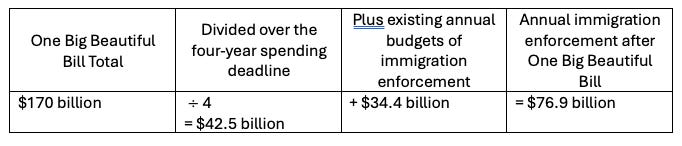
Part of the immigration money in One Big Beautiful Bill goes to enforcement agencies and increases their budget (i.e. more money for ICE), and the other part of the money goes to one-time spending (i.e. money to build detention centers). That one-time spending has a four-year deadline, it has to be spent by 2029 or the money is lost.
So one way to think of this money is it’s $170 billion. Full stop.
The other way to think of this money is that it’s $170 billion over four years, so $42.5 billion a year.
Keep in mind, the government already spends a lot of money on immigration enforcement. This is just the additional funds. So add the $42.5 billion from the One Big Beautiful Bill to the funds already going to immigration enforcement:
Customs and Border Patrol’s $19 billion,
ICE’s $10 billion, plus
$2.2 billion of the Coast Guard’s budget and
$3.2 billion of the Department of Homeland Security’s budget that is used for enforcement.That brings the total to $76.9 billion a year.
The One Big Beautiful Bill brings the total immigration enforcement up to $76.9 billion a year. I’ve summed it up here:
…Versus Other Federal Law Enforcement
In the table below, I show the enforcement area, the agency in charge of it, and their 2025 annual funding. Hat tip to the devoutly Libertarian Cato Institute, who put these figures together on the enforcement side, and the deeply progressive Economic Policy Institute for doing the same for labor law. Add these all together and you get $16 billion annually.
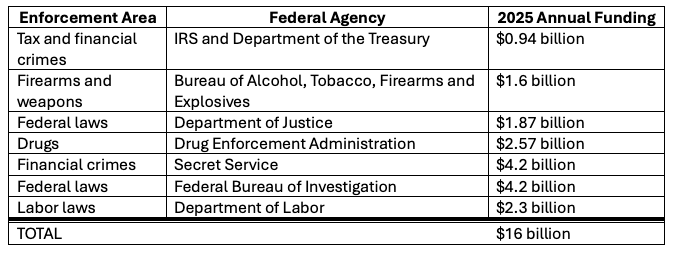
Before beautiful bill: immigration enforcement is double all other federal law enforcement combined.
After beautiful bill ($76.9 billion): it’s nearly five times more
In other words, the federal government devotes more than 80% of law enforcement spending to immigration and less than 20% to all other federal laws.
If you wanted to nitpick, you would point out that this is not the total federal spending on enforcement, these are just the largest agencies. Or that I shouldn’t just look at enforcement dollars, but total budgets (so the entire $9 billion the FBI and not just $4 billion the agency spend on enforcement). You could try to make this as generous as possible and the fundamental imbalance won’t change, maybe it would go from 80-20 to 60-40. The conclusion is the same: the federal government devotes a wild, incredibly lopsided amount of money to immigration enforcement.
…Versus Other State and Local Law Enforcement
To be fair, most law enforcement happens at the state and local level and just a fraction happens at the federal level. Imagine the number of cops in your city versus FBI agents, workplace inspectors, or tax collectors.
In fact: if you were to add up spending on every police department that exists in the US, it came to about $135 billion in 2021. That’s the latest year of complete data we have, so we can assume it’s increased over the past few years. Say it’s $150 billion now. Or even $160 billion.
After beautiful bill ($76.9 billion): immigration enforcement spending is half the size of all state and local law enforcement spending.
Policing 330 million people in the US and enforcing nearly all laws that are on the books gets twice as much money as policing 14 million people in violation of one.
And if you think these law enforcement numbers are wild, just wait to you see how much it compares to spending on children and families.
…Versus Pandemic Relief
So, I hate to ask but: remember the pandemic?
If you think of this $170 billion of immigration enforcement as a short-term, emergency spending, pandemic relief spending is a pretty fair comparison. How much money did pandemic relief spend, and on what, compared to immigration enforcement this summer in the One Big Beautiful Bill?
The big ticket items during the pandemic were economic impact payments to families (aka the three stimulus checks), unemployment benefits for workers who lost their jobs, and the paycheck protection program; each were more than a half a trillion dollars in size. Smaller items include support for state and local governments, K-12 schools, higher education, school meals, to keep workers employed in airlines, restaurants, and entertainment venues, and grants to help child care businesses. And in 2021, the Child Tax Credit was expanded so that all families received it, it was increased to $3,000-$3,600, and deposited directly into bank accounts for six months.
So how does it all stack up? I’ll show this first in dollar amounts:
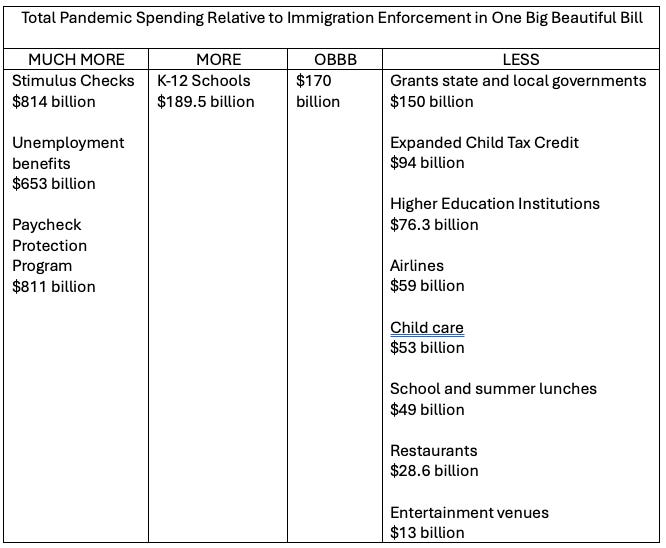
The One Big Beautiful Bill’s infusion of money for immigration enforcement is on par with how much the government sent to K-12 schools and state and local governments in the pandemic, and dwarfs the emergency spending on the expanded Child Tax Credit, higher education, airlines, child care, school meals, restaurants, and entertain venues.
For what it’s worth: developing, testing, producing, and purchasing the Covid-19 vaccine was $32 billion.
…Versus Children
After the beautiful bill, immigration enforcement came to $76.9 billion a year. In comparison, spending on social programs is scant.
The federal government’s commitment to helping families afford child care is the Child Care Development Fund, which sends grants to states to distribute to families. It’s just $12.3 billion in 2025.
When it comes to food, the government is more generous. It funds childhood nutrition programs (like school lunch), Supplemental Nutrition Assistance for low-income families (which used to be called Food Stamps, but the name changed when the government phased out paper stamps), and the Women Infant and Child program that buys very low-income young families formula and certain food items. But of course, all three of those items combined is less than $76.9 billion ($28.2 billion in 2024 for childhood nutrition, $40 billion for kids on SNAP, and $7.2 billion for WIC).
Arguably the most expensive thing the federal government buys for families is health insurance, and it definitely spends a lot of money on Medicaid. But here’s the thing, Medicaid isn’t a flat allotment, i.e. everyone with Medicaid gets $15,000 a year for their health. Instead, it’s a payer based on consumption: the cost of putting a person on Medicaid depends on how much health care they actually consume. So, a 75-year-old who is an elder care facility that Medicaid is paying for costs a lot more than say, a health five-year-old kid.
In fact, just 15% of total Medicaid spending goes to children, accounting for $115 billion. That’s because despite covering half of all kids in the US, kids don’t use that much health care outside of routine visits, so they don’t cost Medicaid that much.
In short: $115 billion to make sure 37 million kids have health insurance versus $76.9 billion to target 14 million unauthorized immigrants for deportation.
I can put this in starker terms.
The Urban Institute, a think tank in DC, puts together an analysis every year called Kids Share, where it combs through the federal budget and tax system and calculates how much goes to children. It then puts it in per person terms: how much does the federal government invest in children on a per child basis?
In 2023, it was around $8,990 per child. That number was expected to fall in 2024-2027 because the last of pandemic funding was winding down and settle close to $8k. (It could fall even more after the One Big Beautiful Bill’s cuts to Medicaid and SNAP, but some of the tax provisions will partially offset it.)
$76.9 billion in immigration enforcement for 14 million unauthorized immigrants comes out to $5,492 per unauthorized immigrant.
Frankly, I don’t like how close those numbers are. About $9k for each child but $5.5k for each unauthorized immigrant.
And It’s Terrible Costs
Sure, all this immigration enforcement costs money. $170 billion in spending costs $170 billion. And while I can show you in painful detail as I have here that that total immigration enforcement is more money than the federal government spends on child care or food for children, and in fact rivals the total federal investment in children, it’s not as if they are in competition. If this $170 billion went away, the money wouldn’t go to children instead. Money isn’t stopping investments in children, a lack of priority is.
So maybe another way to put it is, what does spending $170 billion to target 14 million people risk? A lot, as we see every day in the news. But I wanted to talk about one in particular. Targeting 14 million people indiscriminately for deportation risks 14 million people’s integration into society.
You’ll have probably noticed that I use “unauthorized” rather than “undocumented” throughout, and that’s because undocumented is an inaccurate term. It implies that there is a mass of people in the US that essentially live off the grid, apart from society, existing only in informal economies and off-the-book transactions. But that’s not the case. Unauthorized immigrants are enmeshed in our society with have lots and lots of documents, from tax returns to mortgages.
And there’s a reason for it: up until the dramatic turn in enforcement taken up by the Trump administration, most of our economic and social system was aligned in trying to encourage unauthorized immigrants to participate in society to the fullest extent possible.
Some of it is just a tax calculus. Unauthorized immigrants pay sales taxes for the things they buy. Even without a proper work permit, they pay into Social Security and Medicare through their automatic payroll tax contributions (they aren’t eligible or earning credits for either program) and pay income taxes through automatic withholding.
On top of this, around 5 million, or about half of the undocumented population, voluntarily pays federal income taxes through the use of ITIN aka individual tax identification numbers that are a substitute for a Social Security number for people who don’t have one. They also use ITINs to get driver’s licenses and even apply for a mortgage (yes, they pay property taxes too!)
It’s estimated that unauthorized immigrants’ total tax contribution is over $100 billion.
But a truly inestimable part of it is that the American economy—and our communities—benefit from having 14 million people on the grid, as opposed to off it. Get a job, put kids in school, call 911 when there’s a crime, go to church, get a driver’s license and car insurance, pay taxes—be good, law-abiding citizens in all but name. Those 14 million unauthorized include 9.1 million workers, 4.1 million parents of citizen children, and 6.1 million people who have resided in the US for more than 20 years.
We are risking so much more than money spent, more than taxes not collected, but creating a self-fulfilling prophesy of creating the undocumented in the place of the unauthorized.

Your comparison of spending on law enforcement vs immigration is eye opening. But the one that stopped me in my tracks was the Covid relief comparison. Thanks for this post.
You make it so simple